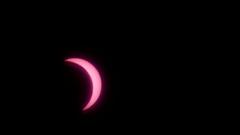
Every time the moon grazes the face of the sun over Northern England, local media loses its collective mind. Headlines pop up across the British Isles screaming about rare astronomical alignments, breathtaking photography, and once-in-a-lifetime spectacles over the Yorkshire moors. Photographers scramble to Whitby Abbey with telephoto lenses. Amateurs pitch tripods in freezing winds near the Dales. They capture the jagged silhouette of a ruined abbey framed by an anemic, crescent sun, and the internet pats itself on the back for witnessing the cosmos in action.
It is exhausting. And it completely misses the point of what an eclipse actually is.
Let us strip away the romanticism and confront the lazy consensus. The common narrative treats a solar eclipse in Yorkshire as some mystical anomaly, a rare visiting dignitary gracing the county with its presence. This is astronomical illiteracy packaged as clickbait. Eclipses are not rare. They are not exclusive. They are the predictable, mechanical result of celestial clockwork that has been mapped to the fraction of a second for centuries.
The Geography of Ordinary Shadows
To understand why the Yorkshire eclipse hype machine is a masterclass in manufactured wonder, you have to look at orbital mechanics rather than local tourist boards.
Solar eclipses happen somewhere on Earth roughly two to five times every single year. Partial eclipses, annular eclipses, total eclipses—they are a regular feature of planetary motion. What changes is merely the intersection of the moon's shadow cone with a rotating sphere covered in oceans and mostly empty land. When that shadow clips Northern England, it is not because the universe picked Yorkshire for a special performance. It is simply math.
Yet, local publications treat a partial solar obscuration over the White Horse of Kilburn as if the heavens parted just for Yorkshire Tea drinkers. Photographers line up for miles to get the exact same shot of a cloud-obscured crescent peeking over a dry-stone wall. They call it rare. I call it a failure of imagination.
The rarity isn't the eclipse. The rarity is our ability to look up from our glowing rectangles long enough to notice the ambient light drop by ten percent while the temperature falls three degrees. We treat basic physics like a miracle because modern life has successfully alienated us from the physical sky.
The Myth of the Perfect Frame
Let us talk about the photography industrial complex that drives these events.
When a celestial alignment hits the UK, social media feeds flood with hyper-saturated images. You have seen them. A massive, impossibly crisp sun hanging directly behind a famous Yorkshire landmark, shot at a focal length that distorts perspective so violently the moon looks the size of a hot air balloon.
Here is what nobody tells you about those viral eclipse shots: they are almost entirely manufactured.
Photographers aren't just standing out in a field waiting for luck. They are using apps like PhotoPills, calculating precise GPS coordinates miles away from the landmark, and using thousand-millimeter lenses to compress the background. They are planning for years, not hours. Which is fine—that takes technical skill. But selling that calculated optical illusion to the public as a spontaneous stroke of natural magic is disingenuous.
Worse, it ruins the actual experience. Thousands of people drive their diesel hatchbacks up to national park viewpoints, congesting narrow rural lanes, all to stare at a tiny sliver of sunlight through protective cardboard glasses they bought on Amazon for five pounds. They spend the entire duration of the event fiddling with camera settings or staring into a viewfinder, completely detached from the visceral, eerie reality of the moment.
If you spend a rare celestial event staring at an LCD screen to capture a cliché composition of a ruined abbey, you didn't experience the eclipse. You worked a freelance photography gig for free.
What the Media Gets Wrong About Astronomy Coverage
The mainstream press coverage of these events relies on a tired formula. Step one: hype up the rarity. Step two: quote a breathless local astronomer who says something generic about "the wonder of the cosmos." Step three: publish a gallery of reader-submitted smartphone photos that look like orange smudges on a grey background.
This approach dumbs down science. It treats astronomy like astrology—something pretty to look at that makes you feel small and contemplative before you go back to checking your emails.
True astronomical literacy doesn't come from gasping at a partial eclipse because the BBC told you to. It comes from understanding why the moon's orbit is tilted at five degrees relative to the Earth's orbital plane. It comes from knowing that the moon is slowly drifting away from our planet at a rate of about 3.8 centimeters per year, meaning total solar eclipses will eventually cease to exist entirely millions of years from now.
That is the real story. Not that you can see a hazy crescent over Leeds, but that we are living in a very narrow window of geological time where the sun and moon appear nearly identical in size from our specific vantage point.
When you frame every regional shadow alignment as a monumental event, you create a culture of drive-by science enthusiasts. They show up for the spectacle, complain about the cloud cover—because let's be honest, it is usually raining in Yorkshire—and forget the cosmos exists until the next headline tells them to look up.
How to Actually Engage with the Sky
If you want to break away from the herd mentality of eclipse-chasing, stop waiting for media conglomerates to tell you when to look at the sky.
The night sky over the North York Moors or the Yorkshire Dales offers genuine, unhyped marvels every single night of the year. Dark sky reserves in the region provide real opportunities to observe deep-space objects that dwarf our local solar system. You can watch the Andromeda Galaxy—light coming from a trillion suns two and a half million years ago—with a modest pair of binoculars, without a single tourist blocking your view.
When an eclipse does roll around, abandon the telephoto lens. Stop trying to document it for an Instagram algorithm that rewards conformity over insight.
Put down the camera. Stand in the cold wind. Watch how the birds go silent. Notice how the quality of the light turns an unnatural, metallic grey, casting sharp, crescent-shaped shadows through the leaves of the trees. Feel the sudden drop in temperature on your skin.
That sensory shift is the only part of the eclipse that matters. No photograph will ever capture it. No viral news article will ever explain it better than your own nervous system processing the strangeness of daytime turning into twilight.
Stop treating the universe like a tourist attraction. Look up, shut up, and pay attention to the physics instead of the PR.