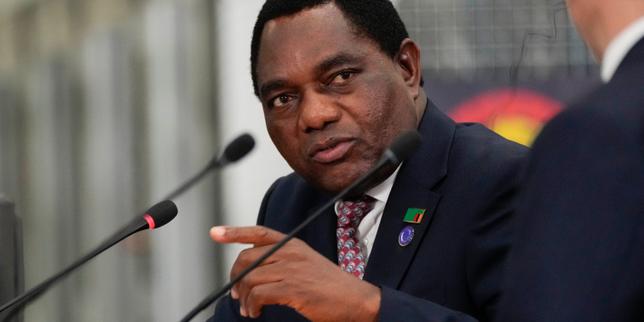
Hakainde Hichilema has secured a second term as President of Zambia, winning approximately 60 percent of the vote according to the Electoral Commission. Yet, beneath the veneer of this predictable outcome lies a nation grappling with a narrowing democratic horizon. While the incumbent celebrates a victory intended to solidify his economic recovery plan, the legitimacy of this exercise is already being shredded by allegations of intimidation, state-sanctioned arrests, and a troubling administrative environment that observers describe as fundamentally uneven.
The core issue is not simply the numerical win, but the climate in which it occurred. During the final days of the count, authorities suspended operations for six hours, citing violence and stolen ballots. While the commission resumed its work under heightened security, the optics were disastrous. European Union observers were blunt, noting that late legal changes and an uneven campaign field distorted the process long before the first ballot was cast.
Brian Mundubile, the opposition leader who managed a surprisingly strong 38 percent share, has signaled his intent to challenge the result, alleging that documentation was tampered with in an attempt to manipulate the tally. Mundubile’s own home was subject to a police raid, an event he characterizes as a direct threat to his life—a stark contrast to the standard, peaceful transitions that once defined Zambian politics since 1991.
The government’s response has been to pivot toward state security narratives. Officials claimed the arrests of opposition figures were necessary to suppress "militia activity," a charge that Mundubile’s party categorically rejects as a fabrication designed to delegitimize dissent. This rhetoric is a departure from the open discourse expected in a functioning multiparty democracy. It suggests that the administration is increasingly willing to deploy the machinery of the state to silence its loudest critics.
Economically, Hichilema’s tenure has been a study in high-stakes stabilization. After inheriting a debt-ridden copper giant in 2020, his team oversaw complex debt restructuring and managed to curb the rampant inflation that previously crippled the currency. To his supporters, these actions are the bedrock of a modernizing Zambia. However, these macroeconomic wins have failed to filter down to the majority. With over 70 percent of the population surviving on less than three dollars a day, the promise of prosperity feels increasingly disconnected from the lived reality of the average citizen.
The danger for Zambia is that the current administration interprets this mandate as a green light to continue its trajectory of centralized control. When an incumbent wins while simultaneously restricting the operational space of their opponents, they do not just win an election; they signal the beginning of a transformation that often leads to institutional erosion. The Zambia Conference of Catholic Bishops has already raised alarms about the deployment of military assets during the count, rightly pointing out that maintaining order is a police responsibility, not a job for the armed forces.
This electoral cycle reflects a broader trend across the region where leaders leverage the language of economic stability to justify the compression of political freedoms. The international community often watches these shifts with a weary eye, hoping for a return to the status quo while the fundamental building blocks of democracy are quietly replaced.
The opposition's call for an independent investigation into the alleged tampering of results forms the next phase of this tension. Whether or not there is concrete proof of systemic fraud is almost secondary to the perception of it; once the electorate loses faith in the mechanics of the ballot, the damage is difficult to undo. By relying on security raids and administrative obfuscation, the government has traded long-term credibility for a short-term victory.
The challenge ahead for the administration is not just the management of the national debt, but the reconstruction of a shattered social contract. If the government continues to view opposition as insurgency rather than a natural part of a vibrant state, the current stability will prove to be an illusion. A democracy cannot thrive on fear, and a mandate built on the exclusion of the dissenting voice is a mandate that invites volatility.
As the country moves forward, the focus shifts to the legal challenges and the international community's willingness to hold the process to account. The outcome of these appeals will determine if this election serves as a foundation for a new era or as a definitive warning sign of an incoming decline.
This video provides additional context regarding the atmosphere and critical reception surrounding the recent Zambian election.
http://googleusercontent.com/youtube_content/1