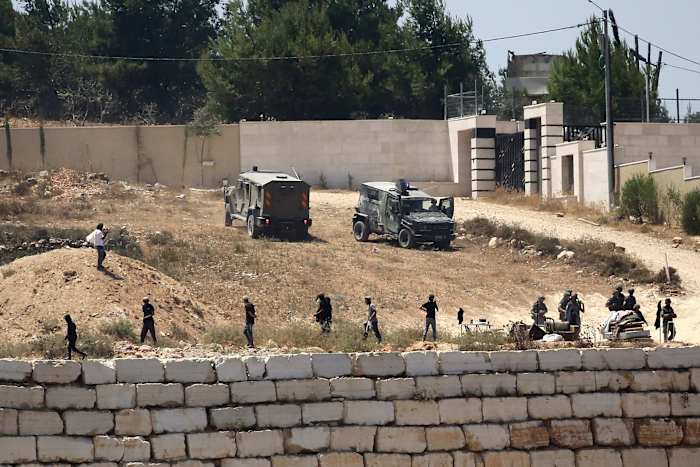
Diplomatic vocabulary relies on precision to signal shifts in policy, deterrence thresholds, and legal liability. When a senior State Department official publicly categorizes an incident involving Israeli settlers in the West Bank as an act of terror, the statement operates as more than rhetorical escalation. It functions as a diagnostic marker for how state actors map accountability, resource protection, and domestic security failures in occupied territories. Understanding this shift requires moving past political posturing to analyze the underlying structural incentives, legal categorizations, and security bottlenecks that govern state responses to sub-state violence.
The Jurisdictional Matrix of West Bank Security
Governance in the West Bank operates through a fragmented legal architecture established by the Oslo Accords, divided into Areas A, B, and C. This administrative division creates a jurisdictional vacuum where law enforcement responsibilities overlap, compete, or intentionally lapse.
Area C, under full Israeli military control, presents a distinct structural vulnerability. Security responsibility rests entirely with the Israel Defense Forces, while domestic policing for Palestinian residents falls under military law, and Israeli settlers are governed by civilian Israeli law administered extra-territorially. When state security apparatuses fail to police ideological violence perpetrated by citizens within their own legal jurisdiction, systemic impunity takes root.
The application of the term terror by an external diplomatic actor targets this exact enforcement gap. In international relations, labeling a domestic actor a terrorist shifts the analytical framework from common criminality or localized civil unrest to systemic state failure or complicity. The primary variable is not the weapon used or the physical damage inflicted, but the intent to coerce a civilian population through systematic violence to achieve ideological displacement.
The Mechanics of Ideological Displacement
Ideological violence in this theater functions through a predictable operational model designed to alter demographic facts on the ground without incurring direct state-to-state military engagement. The mechanism relies on three distinct phases:
- Incipient Encroachment: The establishment of unauthorized outposts or agricultural holdings adjacent to Palestinian communities, testing the baseline security response thresholds of the occupying power.
- Economic Attrition: Systematic targeting of livelihood assets, including olive groves, livestock, and water infrastructure, designed to raise the baseline cost of physical presence for indigenous populations to an unsustainable threshold.
- Coercive Expulsion: Direct physical intimidation or night raids targeting residential structures to trigger mass displacement, converting contested land into homogenous security zones.
When diplomats intervene rhetorically, they are identifying phase three as an active security failure rather than an isolated property dispute. The strategic objective of this categorization is to force a re-allocation of military assets away from offensive deterrence against external state actors and toward internal policing of domestic extremists.
The Economic and Diplomatic Cost Function
Every security posture maintains an economic and diplomatic cost function. For the United States and allied Western governments, maintaining unconditional diplomatic cover for an ally while unchecked sub-state violence accelerates creates severe liabilities in multilateral forums.
The cost function for the host state involves balancing domestic political coalitions against international compliance frameworks. When settler violence crosses the threshold from localized friction to state-acknowledged terrorism, international financial institutions, bilateral trade partners, and human rights monitoring bodies increase compliance scrutiny. Visa bans, asset freezes, and targeted sanctions against specific individuals represent the initial calibration of this cost function.
These punitive measures are designed to impose tangible friction on actors who previously operated with structural immunity. However, the efficacy of targeted sanctions remains limited when local political authorities rely on the perpetrators' legislative or demographic constituency for coalition survival.
The Security Dilemma of the Enforcing Power
The military forces tasked with maintaining order in the West Bank face a profound operational dilemma. Soldiers deployed to the territory are trained for counter-insurgency and external defense, not municipal policing or civil law enforcement against politically aligned citizens.
When soldiers witness ideological violence and fail to intervene, the institutional failure stems from a breakdown in the chain of command caused by ideological capture or conflicting operational directives. The military command structure prioritizes border stability and the suppression of organized militant threats over the protection of civilian populations belonging to the occupied demographic. This creates a moral hazard where the presence of the military provides a protective umbrella for aggressive settler actions, effectively outsourcing territorial control to extremist elements.
Diplomatic pressure attempts to alter this calculus by making institutional inaction more costly for military commanders than enforcing the law against citizens. Yet, changing field behavior requires shifting internal promotion metrics, establishing independent military police oversight, and dismantling the informal protections that shield perpetrators from indictment in military courts.
Strategic Realignment and Enforcement Metrics
Resolving the structural crisis in the West Bank requires moving past diplomatic semantic debates toward quantifiable enforcement metrics. The measurement of success cannot rely on verbal condemnations or temporary travel restrictions. True mitigation requires specific operational shifts:
- Prosecutorial Parity: Eradicating the dual legal system where Palestinian suspects face military detention while Israeli suspects enjoy civilian due process and negligible prosecution rates for ideological crimes.
- Asset Interdiction: Dismantling the financial networks, international fundraising platforms, and state-subsidized infrastructure that fund unauthorized outposts and violent organizations.
- Command Accountability: Enforcing strict rules of engagement that mandate immediate military intervention to protect civilian populations regardless of their demographic or national identity.
Until these structural changes are implemented, diplomatic labels will remain diagnostic symptoms of an unmanaged crisis rather than instruments of resolution. The trajectory of the region will continue to be dictated by the speed at which unchecked ideological violence forces a permanent collapse of local governance structures, compelling external powers to escalate from rhetoric to comprehensive structural intervention.