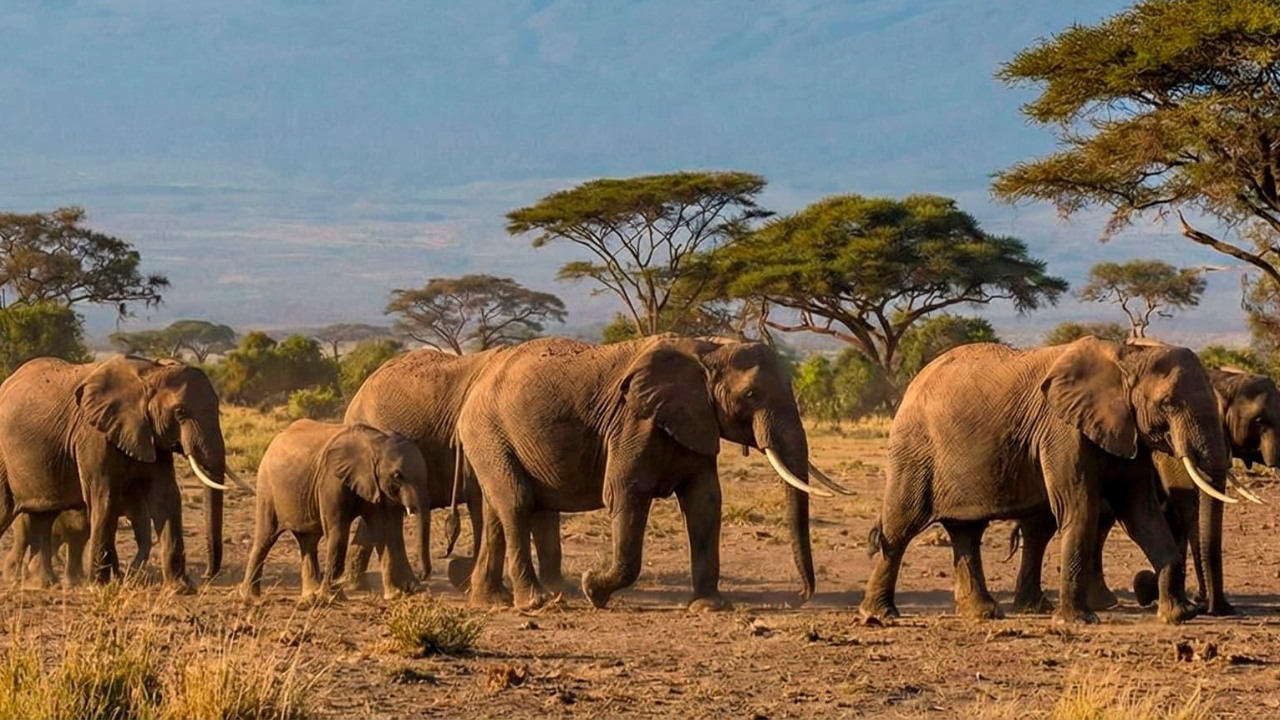
The dust of the Tsavo ecosystem does not settle easily. It clings to the soles of your boots, coats the dry thornbushes in a pale grey film, and carries the ancient, heavy scent of sun-baked earth mixed with acacia resin. If you have ever walked that ground, you know the silence of a drought-stricken afternoon. It is not an empty silence. It is a dense, watchful quiet, punctuated only by the sharp call of a red-billed hornbill or the dry rattle of pods shifting in the wind.
Then, silence breaks.
Imagine standing near the edge of a smallholder farm where the green line of cultivation abruptly surrenders to the bone-colored dust of the wild. To understand what happened when fifteen elephants collapsed into that dust, we have to look past the cold administrative language of wildlife reports. We have to look at the intersection of desperation, chemistry, and a fragile boundary line that humans and animals cross every single day.
Kenya Wildlife Service officials did not expect to find what they found. Fifteen bodies. Not scattered across decades, but fallen within a horrifyingly brief window. Giants that had weathered decades of drought, poachers, and shrinking migration corridors, brought low not by a spear or a bullet, but by a chemical compound whispered about in hushed tones among local authorities: cyanide.
Cyanide is a brutal molecule. It works with terrifying speed, short-circuiting the body's ability to use oxygen at a cellular level. It turns a living, breathing mountain of muscle and intelligence into a still monument within minutes. And it was found in the bodies of these elephants, linked directly to tomato pesticides used on the farms bordering the park.
To grasp the weight of this tragedy, you have to understand the daily geometry of survival in East Africa.
Picture a farmer named Juma. (This is a composite scenario, built from the lived realities of agricultural communities sharing borders with protected lands). Juma wakes up before dawn. The air is cool, smelling of woodsmoke and damp soil. His livelihood hangs on a few acres of tomatoes, irrigated laboriously from a dwindling river or a deep borehole. These crops are his children's school fees, his medicine, his future.
For months, he has watched the skies fail. The seasonal rains arrived late, dropped a mocking mist, and vanished. And then, in the dead of night, the fence line trembles.
To an elephant, a smallholder's irrigated tomato field is an oasis of succulence. It is a dense cluster of water-rich fruit and green foliage standing out against a sea of dry brush. The temptation is absolute. A family herd moves in, sweeping through rows in minutes, flattening months of backbreaking labor into a muddy slurry of crushed stems and ruined fruit.
When you lose your harvest in a single night, panic takes over. Rational thought erodes. Desperation whispers terrible solutions.
Agricultural chemicals, designed to protect crops from voracious insects, are easily accessible in local markets. They are tools meant to kill pests. But when the pests weigh six tons and stand ten feet tall, the scale of intervention shifts. The use of toxic substances to deter or eliminate wildlife is a dark, desperate escalation of a conflict that has been simmering for decades.
When the first elephant drank from a contaminated pool or ingested treated foliage, it felt no warning. The poison bypassed the slow agony of starvation and went straight for the breath.
We talk about conservation in grand, sweeping terms. We discuss corridors, policy frameworks, and anti-poaching patrols. But conservation is ultimately lived out in the dirt, on the exact millimeter where human need grinds against wildlife instinct.
When fifteen elephants die in an incident like this, the shockwave ripples far beyond the immediate site. It hits the social fabric of the herds. Elephants are complex, deeply emotional creatures. They mourn their dead. They stand vigil over the bones of their matriarchs, touching the skulls with sensitive trunks, rumbling in frequencies too low for the human ear to catch.
Field rangers who witnessed the scene spoke of the eerie quiet left behind. The surviving herd members did not vanish immediately; they lingered at a distance, their ears fanning slowly, waiting for leaders who would never rise again.
This is the hidden cost of our global food systems meeting local ecological pressures. Every tomato, every head of cabbage, every ear of corn grown at the edge of the wild carries a story of negotiation. When that negotiation breaks down, chemistry steps in to arbitrate. And chemistry has no mercy.
Authorities are now scrambling to reevaluate how restricted pesticides are monitored, distributed, and used in buffer zones. But regulations on paper do not feed a farmer whose crop was flattened at midnight. Laws do not replace a destroyed harvest.
To fix this, we have to look past blame and address the architecture of coexistence. We need better deterrents that respect both human survival and animal intelligence. We need early-warning systems that give farmers a fighting chance before the herds arrive. We need economic safety nets that acknowledge that living next to the world's largest land mammals is a burden shared on behalf of all humanity.
The dust of Tsavo is settling again. The vultures have come and gone. The bones of the fifteen are bleaching under the equatorial sun, becoming part of the landscape they once walked as kings.
A heavy wind sweeps across the plains, rattling the dry acacia thorns and carrying the faint, sweet scent of distant rain that may or may not arrive.