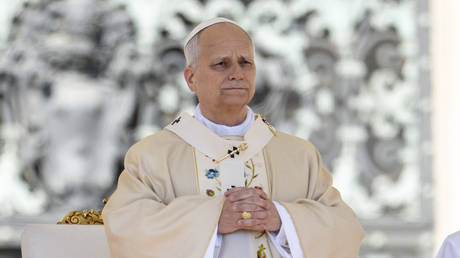
The media loves a "quirky" headline. When news broke that Pope Francis was repeatedly hung up on by a bank representative because they thought he was a prankster, the internet reacted with the usual mix of "stars—they’re just like us" and "how embarrassing for the bank."
They missed the point. Entirely. Expanding on this topic, you can also read: The Iron Pit and the Shadow War.
This isn't a story about a humble Pope or a confused customer service rep. This is a post-mortem on the absolute failure of modern verification systems and the erosion of human judgment in an era obsessed with "security protocols." We have built a world where if you don’t fit the statistical profile of a standard user, you don’t exist. Even if you’re the Bishop of Rome.
The Fraud of Modern Security
Most commentary focused on the humor of the situation. I see a systemic collapse. For years, I’ve watched financial institutions sink billions into "identity verification" and "KYC" (Know Your Customer) frameworks. The irony is staggering. The more tech we throw at identity, the less we actually know the person on the other end of the line. Analysts at Harvard Business Review have provided expertise on this matter.
The bank employee wasn’t being lazy. They were being a perfect cog in a broken machine. In modern banking, the "False Positive" is the ultimate sin. Employees are trained to treat any anomaly as a threat.
When a caller claims to be the Pope, the algorithm in the employee’s head triggers a "High-Risk/Low-Probability" flag. Instead of using ears, context, or—heaven forbid—intuition, the system defaults to rejection. We’ve incentivized "No" because "No" is safe. "Yes" requires accountability.
The Vatican vs. The Database
Let’s dismantle the "People Also Ask" nonsense surrounding this event. People want to know: How could they not recognize his voice?
The question assumes the voice matters. In the current banking infrastructure, your voice is just data. If that data doesn’t match a pre-existing voiceprint or if the metadata of the call (originating from a private Vatican exchange) looks "spoofed," the human on the other end is instructed to ignore their own senses.
I’ve consulted for fintech firms where the directive is clear: Trust the dashboard, not the dialogue.
This creates a reality where a sophisticated AI deepfake that mimics the Pope perfectly—but originates from a "trusted" IP address—would pass through security faster than the actual man calling from a landline. We are optimizing for the map, not the territory.
The High Cost of the "Standard User" Assumption
The "lazy consensus" in business writing suggests that we need better AI to solve this. That’s a lie. More AI just creates a narrower definition of what a "normal" human sounds like.
Most systems are built for the 80%—the suburban professional with a predictable spending pattern and a standard smartphone. If you are an outlier—a high-net-worth individual, a person with a rare accent, or a Pope calling from a 16th-century palace—you are a "bad actor" by default.
- Logic Failure: The bank’s protocol assumed a prank was more likely than a miracle.
- Data Failure: The system couldn’t reconcile the "Pope" identity with a "Standard Caller" behavior.
- Human Failure: The rep feared the disciplinary action of being "fooled" more than the reputational risk of hanging up on a world leader.
The Intuition Gap
I’ve seen legacy banks lose their best clients because they replaced relationship managers with "automated risk scoring."
In the old world, a banker knew your voice. They knew your family. They knew your business. That wasn't "inefficient"—it was the highest form of security. It was unhackable because it was based on biological reality and shared history.
By "scaling" trust through digital gatekeepers, we’ve made it brittle. We’ve traded deep, narrow security for shallow, wide surveillance. The Pope getting hung up on is just the most visible symptom of a disease affecting every person who doesn't fit into a tidy data bucket.
Stop Trying to "Fix" Customer Service
The common advice is to "train staff better." Waste of time. You can’t train a human to be a human while simultaneously forcing them to follow a rigid, automated script.
The fix isn't more training; it's Discretionary Power.
If an employee doesn't have the authority to say, "This sounds crazy, but let me check one level higher before I hang up," then you don't have an employee. You have a biological placeholder for an API.
The Reality of Risk
Is there a downside to giving humans back their intuition? Of course. Humans can be socially engineered. A clever con artist can talk their way past a sympathetic ear.
But look at the alternative. We are building a society where the truth is discarded because it doesn't meet the "verification requirements" of a mid-level software suite. We are so afraid of being "pranked" that we’ve become unable to accept reality when it arrives unannounced.
If the Pope can't prove who he is, what chance do you have when your identity is stolen, or your life doesn't fit the "Standard User" profile?
The bank didn't fail to recognize the Pope. They failed to recognize a human being. And in the race to automate everything, that’s the one error the "experts" keep calling a feature.
Security that can't handle the truth is just a high-tech version of closing your eyes and hoping for the best.
Stop calling it a prank. Start calling it a systemic collapse.