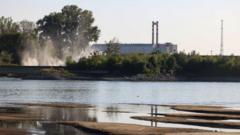
You smell the water before you see it in the middle of August. It does not smell like a river. It smells like old copper, baked mud, and something heavy resting at the bottom of a shallow pan.
Stand on the banks of the Danube at Paks, and you are standing at the thumping heart of Hungary. Half of the nation’s electricity does not come from distant windmills or coal-blackened pits. It comes from four Soviet-designed VVER-440 reactors sitting inside stout, windowless concrete boxes just yards from the current. They drink from this river. They breathe its coolness. They exhale warmth back into its sluggish green spine. For a deeper dive into this area, we recommend: this related article.
Water is the lifeblood of power. We forget this. We treat electricity as an invisible grace that spills effortlessly out of a white wall socket, untethered from geography or weather. But electricity has weight. It has temperature.
And the river is running dry. For additional background on this development, comprehensive reporting can be read at BBC News.
I remember standing by a similar stretch of the Rhine years ago during a drought that cracked the earth into jigsaw puzzles. A local fisherman named Imre—a hypothetical name for a very real kind of weathered man who spends his life reading the surface tension of currents—pointed to a rusted iron marker near the piling.
"Look at that bolt," he told me, wiping sweat from a sun-browned forehead. "My grandfather used to tie his flat-bottomed boat three feet above that ring in June. Now? The fish are huddled in the deep pools like sheep in a storm. The water is too warm to hold breath."
When water gets too warm, it stops working. That is the quiet, terrifying physics of thermal power plants. Nuclear reactors do not magically create energy from thin air; they move heat. They boil water, drive steam turbines, and then they need a vast, unyielding sink to absorb the leftover thermal exhaust. Nature provides that sink. Nature, however, is currently baking under stationary high-pressure domes that refuse to move.
As of late, the Danube has dropped to historic lows. The gauges at Paks do not just measure depth; they measure a countdown.
Consider what happens inside the reactor core when the intake drops.
It is a delicate, unforgiving dance of thermodynamics. The water entering the plant must be cold enough to condense steam back into liquid after it has screamed through the turbine blades. If the river temperature creeps past strict environmental thresholds, or if the volume drops so low that the pumps begin to suck mud and air instead of liquid, the operators face a nightmare choice.
Shut it down. Or risk a catastrophic core overheat.
A shutdown at Hungary’s only nuclear facility is not like flipping a light switch. It is a slow, methodical bleed of capacity. Power output is dialed back. The grid shudders. Imports from neighboring countries spike, driving up spot prices across Central Europe in a domino effect that leaves factory owners in Budapest and families in small villages staring at gas bills they cannot afford.
This is the invisible stake of climate change. It does not always arrive with the cinematic fury of a coastal hurricane or a roaring wildfire. Sometimes, it arrives as silence. The sudden, unnatural quiet of a massive turbine winding down because the river it loves has turned into a lukewarm puddle.
Experts talk about cooling towers and ecological limits as if they are abstract entries in a regulatory handbook. They use words like thermal discharge compliance and hydrological deficit.
They are missing the poetry of the crisis.
The Danube does not care about compliance. It flows through ten countries, gathering the runoff of melting Alpine snows and summer thunderstorms, carrying the history of empires and trade routes. When it shrinks, it exposes things long forgotten. Old barges from World War II, loaded with explosives, poke their jagged metal spines out of the receding mud near Prahovo. Boulders carved with ancient warnings—Hungarorum inscriptions warning of famine and dry years—break the surface like jagged teeth.
History is warning us. We are just refusing to translate the language.
When Paks throttles back, the grid wobbles. Hungary imports a significant chunk of its electricity from regional neighbors who are facing the exact same dry riverbeds, the exact same heatwaves, and the exact same impossible choices. You cannot easily import power when the entire continent is gasping for air.
We built our modern world on the assumption of abundance. We assumed rivers would always run thick, that the sky would always provide rain, and that the industrial machinery of the twentieth century could run forever on autopilot.
Now, the math is catching up.
The expansion project at the site, known as Paks II, aims to add new reactors to the complex. Billions of euros are tied to concrete, steel, and geopolitical alliances. Yet, every blueprint drafted in sterile corporate boardrooms fails to account for a fundamental variable: Can you build a monument to future energy on a foundation that is drying up?
The answer requires a new kind of honesty. We have to look at our infrastructure not as permanent monuments, but as fragile organisms tethered to the pulse of a changing planet.
The sun is dipping below the low, flat horizon of the Hungarian plain, casting a bruised, coppery light across the surface of the Danube. The cooling towers of Paks rise against the dusk, silent monoliths venting pale white plumes into a sky that offers no rain.
Somewhere inside those thick walls, engineers are watching the monitors. They are watching the mercury climb. They are watching the digital gauges tick downward, inch by unforgiving inch.
The river keeps moving, carrying its secrets toward the Black Sea, lighter and warmer than it was a generation ago, leaving behind a nation holding its breath in the dark.